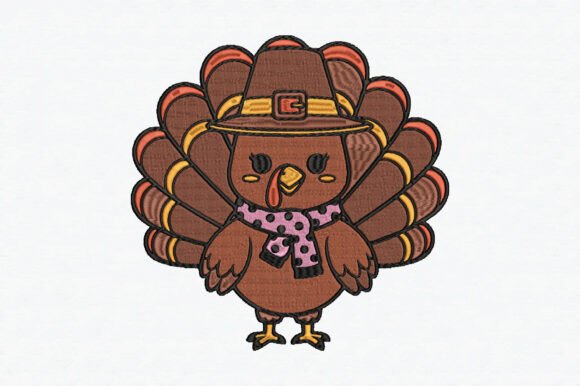
Cute Turkey Embroidery Design
First Impressions: Charming, Cohesive, and Instantly Seasonal
As an embroidery designer who’s stitched hundreds of holiday-themed machine embroidery designs, I opened the Cute Turkey Embroidery Design expecting something sweet—but what stood out immediately was its visual balance. The turkey wears a classic pilgrim hat and a delicate bow, and the composition feels intentional, not cluttered. There’s gentle personality in the pose and expression—friendly but not cutesy to the point of distraction. This isn’t just clipart translated to stitches; it reads like a thoughtful embroidery file built for real fabric, with clear satin stitch outlines, soft fill stitch areas, and subtle running stitch details that suggest movement and texture.
Fits Naturally Into Real-World Projects
I reviewed the Cute Turkey Embroidery Design while prepping for a client order: a set of linen kitchen towels for a local boutique’s Thanksgiving launch. It worked beautifully at 3.5" wide—tight enough for towel hems yet detailed enough to read clearly. I also tested it on a lightweight cotton apron and a midweight baby blanket, both with standard tear-away stabilizer. In each case, the design held its shape without puckering or distortion. Its proportions lend themselves especially well to items where charm and clarity matter more than bold scale—think pillow covers, embroidered patches, tote bag corners, and cap fronts (with proper hooping support).
Performance Across Fabric Types & Use Cases
The Cute Turkey Embroidery Design performs reliably across common substrates—but with important caveats. On stable woven fabrics like cotton twill, denim, or linen, it stitches cleanly with minimal thread breaks or tension issues. On stretchy knits (like sweatshirt fleece or baby onesies), I recommend using cut-away + topping for crispness—especially around the bow and hat brim, where fine satin stitch lines can distort. For dark fabric, contrast matters: the pilgrim hat’s black detail reads well only with high-contrast thread (e.g., white or cream), so I always check thread color pairings before stitching a batch.
On curved surfaces—like structured caps—the design’s compact footprint helps. At under 4" wide, it fits comfortably in most 4x4 hoops without requiring re-hooping. That’s a practical win for small-batch custom apparel or craft fair production. I did notice one area worth testing: the tiny bow knot has dense fill stitch. On thick terrycloth towels or quilted pillow covers, it benefits from light trimming after stitching to avoid bulk. Not a flaw—just a detail that rewards attention.
Commercial & Creative Value for Sellers
For Etsy sellers and handmade shop owners, the Cute Turkey Embroidery Design adds quiet professionalism to seasonal listings. It doesn’t scream “holiday sale”—it whispers “thoughtful, made-with-care.” That tone elevates perceived value: customers pay more for embroidered baby blankets when the motif feels cohesive and intentional, not generic. I’ve used it in printable mockups for social media, and it photographs exceptionally well—soft shadows, clean edges, balanced negative space—making product shots feel cohesive with brand aesthetics.
It also supports brand consistency. Because the design avoids over-the-top novelty (no glitter fonts or exaggerated cartoon eyes), it pairs naturally with neutral palettes, rustic typography, and minimalist packaging. That makes it versatile across niches: farmhouse home goods, modern nursery decor, boutique apparel, even small-batch foodie gifts (think embroidered tea towels for a local maple syrup producer).
Where It Shines—and Where to Pause
- Tote bag design: Perfect centered on the front pocket or subtly tucked into a corner—adds warmth without overwhelming.
- Sweatshirt embroidery: Works best on crewnecks or raglans with flat chest panels; avoid ribbed cuffs or curved hems unless using adhesive stabilizer.
- Embroidered patch: Clean edge definition means it cuts easily and sews on smoothly—ideal for iron-on or sew-on applications.
- Baby items: Soft stitch density and rounded shapes make it safe and tactile—just verify thread safety if selling as a chewable item.
- Commercial embroidery: Licensing allows use in finished products you sell—confirm terms on the Creative Fabrica product page before launching wholesale lines.
Practical Notes Before You Stitch
Before committing to a full run, always:
- Run a test on scrap fabric matching your final substrate—even slight variations in weight or weave affect stitch behavior.
- Review stitch density visually in your embroidery software. Dense areas (like the bow) may need reduced speed or extra stabilizer on textured surfaces.
- Confirm hoop size compatibility. If your machine uses 3.5x3.5" hoops, verify the Cute Turkey Embroidery Design fits—or plan for re-hooping.
- Compare light and dark fabric mockups side-by-side. Some details (like fine pilgrim hat shading) vanish on black without careful thread selection.
- Use appropriate stabilizer: tear-away for stable wovens, cut-away + topping for knits or heavy textures.
- Inspect small details post-stitching—especially the bow knot and eye highlights. A quick snip with sharp embroidery scissors restores clarity.
- Double-check file formats and licensing on the Creative Fabrica product page. Commercial embroidery rights vary by seller, and file compatibility (PES, DST, JEF, etc.) affects workflow.
A Thoughtful Addition to Your Thanksgiving Design Assets
The Cute Turkey Embroidery Design won’t replace complex applique designs or statement monograms—but it fills a quiet, valuable niche: approachable, repeatable, and emotionally resonant seasonal stitching. It works because it respects the craft: no excessive jump stitches, logical thread color changes, and smart layering that minimizes trims. For embroidery designers building digital embroidery files, small business owners curating handmade product lines, or crafters preparing for fall markets, it’s a dependable, photogenic, and commercially sound choice. It doesn’t shout “Thanksgiving”—it invites warmth, nostalgia, and care. And in handmade work, that’s often the strongest stitch of all.