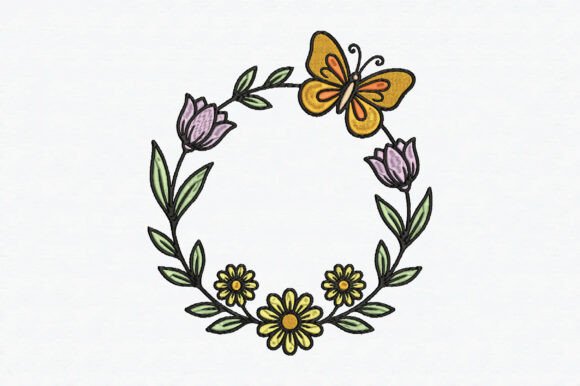
Floral Frame with Butterfly Embroidery
A Delicate Wreath That Lands Just Right
First impression? This isn’t a bold statement piece—it’s a quiet, confident whisper of elegance. The Floral Frame with Butterfly Embroidery opens with soft curves: a circular wreath of petite blossoms and slender stems, cradling a central butterfly whose wings carry subtle veining and gentle contouring. There’s no aggressive density or sharp geometry—just balanced negative space, intentional breathing room between elements, and a clear focal point that invites the eye without demanding it. It feels like something you’d stitch for a baby’s linen blanket or a boutique apron—not a festival hoodie or a trucker cap. Its personality is gentle, feminine, and quietly refined. That matters more than you think when choosing embroidery for real-world products.
Where It Shines in Real Projects
I recently tested the Floral Frame with Butterfly Embroidery on a natural linen tea towel for a local kitchen goods pop-up—and it performed exactly as hoped. The wreath framed the top corner cleanly, the butterfly sat centered without overwhelming the fabric’s texture, and the overall effect read as “thoughtfully handmade,” not mass-produced. It works especially well for:
- Personalized gifts: A monogram tucked subtly inside the frame adds warmth without clutter—ideal for wedding guest towels or baby shower keepsakes.
- Boutique apparel: On a cream-colored organic cotton sweatshirt, it reads as elevated but approachable—perfect for small shop branding that avoids trend-chasing.
- Embroidered patches: Clean outer edges and moderate stitch density mean it presses flat and sews on smoothly, even with lightweight backing.
- Nursery decor: Stitched onto a muslin wall hanging or crib sheet, its softness mirrors the tenderness of the space—no harsh lines or visual noise.
- Etsy listings: As a digital embroidery file, it photographs beautifully in printable mockups—especially on light backgrounds where delicate fill stitch details stay legible.
Where to Pause and Plan Ahead
This design doesn’t shout—but that also means it won’t rescue weak execution. On textured fabrics like terry cloth or bouclé, the fine stem work can blur. On stretchy knits (think baby onesies or fitted tees), skip direct stitching unless you’re using cutaway stabilizer and a tear-away topper—otherwise, those slender petals may pucker or distort. Dark fabrics demand careful thread color testing: light pastels can fade into the background, while stark white may look clinical instead of airy. And avoid hooping it tightly on curved surfaces like caps—the wreath shape resists distortion less gracefully than a vertical motif would.
Also note: the butterfly’s wingtips and the outermost flower buds are where detail lives. If your hoop size is under 4 inches, or your machine struggles with tight satin stitch transitions, those areas may need a test run. Don’t assume it’ll scale down perfectly to a 3-inch hoop without checking stitch density and jump stitch placement first.
What It Adds to Your Finished Product—Beyond Pretty
Customers don’t buy embroidery—they buy intention. The Floral Frame with Butterfly Embroidery signals care, attention to composition, and a respect for quiet beauty. On a handmade tote bag, it elevates perceived value without raising price points. On a personalized gift, it communicates thoughtfulness—not just “I added embroidery,” but “I chose something that suits *you*.” For Etsy sellers, that translates directly to better reviews (“so elegant,” “exactly what I pictured”) and repeat buyers who trust your eye. It also supports brand consistency: if your shop leans into botanical minimalism or cottage-core charm, this design reinforces that voice across product categories—tea towels, pillow covers, baby rompers—without feeling repetitive.
It’s not flashy enough for high-contrast streetwear, nor dense enough for heavy-duty workwear. But for craft businesses building identity around authenticity and tactile quality? It’s a reliable, versatile asset.
Practical Designer Notes Before You Stitch
Before committing to a client order or bulk production:
- Test on scrap fabric first—especially if using textured, dark, or stretchy material. Watch how the outer wreath holds shape after washing.
- Check thread color contrast in both natural and artificial light. A pale yellow butterfly on oatmeal linen looks warm in daylight but flat under store lighting—adjust accordingly.
- Review stitch density in your embroidery software. Look for overfilled petals or overly tight satin borders that could cause stiffness or thread breakage.
- Confirm hoop size compatibility. If your standard hoop is 4×4, verify the design fits comfortably with ⅛” margin—don’t force it.
- Inspect small details at 200% zoom: are wing veins readable? Do flower centers have clean fill stitch transitions?
- Test black-and-white mockups—many customers browse in grayscale thumbnails. Does the shape remain distinct without color cues?
- Compare light vs. dark fabric backgrounds in your digital preview. Some designs lose hierarchy on darks; this one holds up well, but only if thread contrast is intentional.
- Use proper stabilizer: medium-weight cutaway for knits, tear-away for stable wovens, and a light topping for napped fabrics.
- Verify licensing before selling finished items or bundling the embroidery file commercially—this applies whether you’re an Etsy seller, craft fair vendor, or wholesale decorator.
Final Thought: A Design That Earns Its Place
The Floral Frame with Butterfly Embroidery won’t go viral on social media—but it will earn quiet praise from customers who notice the difference between “embellished” and “considered.” It belongs in the toolkit of designers who understand that restraint, balance, and context matter more than complexity. Whether you’re stitching a holiday gift for a friend or building a cohesive line of nursery essentials, this embroidery file delivers consistent, graceful results—provided you meet it halfway with smart prep and thoughtful fabric pairing. In the world of Bugs and Embroidery motifs, it reminds us that delicacy, when executed with precision, is never weak. It’s simply waiting for the right moment—and the right hand—to bring it to life.