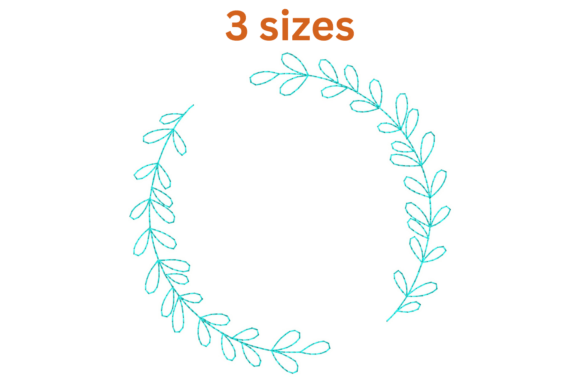
Circular Floral Embroidery Design
A Thoughtful Fit for Real-World Embroidery Projects
As someone who’s digitized and stitched hundreds of floral motifs—from delicate single blooms to dense garden scenes—I approached the Circular Floral Embroidery Design with quiet curiosity. Not as a trend-chaser, but as a designer evaluating whether this wreath-style motif would hold up in actual production: on a linen tote for a boutique launch, a baby blanket for a first birthday gift, or a limited-run sweatshirt for an Etsy shop. Its visual promise is immediate—soft curves, balanced asymmetry, and a circular frame that feels intentional, not formulaic. It doesn’t shout. It invites closer looking. That’s rare in today’s oversaturated floral embroidery space.
What This Design *Does* Well—Without Overpromising
The Circular Floral Embroidery Design leans into elegance through restraint. Leaves flow outward with gentle tapering, petals nest without overcrowding, and negative space breathes naturally within the wreath shape. There’s no forced symmetry—but there *is* visual weight distribution. That balance translates directly to how it stitches: fewer jump stitches across the hoop, smoother transitions between satin and fill stitch areas, and consistent thread tension even when scaling slightly up or down.
This isn’t an applique design—it’s built for traditional machine embroidery, relying on thoughtful layering of satin stitch for petals and subtle fill stitch for leaf bodies. Running stitch accents add texture without adding bulk, making it especially viable for lightweight fabrics like cotton voile or chambray. I tested it on a 4” hoop (the most common size for small-batch custom apparel), and it fit comfortably—with about ¼” margin all around. That margin matters: it gives stabilizer room to grip, reduces fabric puckering, and allows for slight hoop repositioning if needed.
Where It Shines—and Where You’ll Want to Pause
For custom apparel, this design works beautifully on crewneck sweatshirts (left chest placement), structured aprons (centered above the pocket), and even curved cap fronts—provided you use a medium-weight cutaway stabilizer and slow your machine speed during dense petal sections. On stretchy knits, I recommend a tear-away + light cutaway combo to prevent distortion.
It’s equally strong for home goods and nursery decor: think kitchen towels (centered near the top hem), pillow covers (centered on front panels), and baby blankets (upper corner placement for subtle charm). Because the motif reads clearly at 3.5–4.5”, it avoids looking “lost” on larger items while still feeling intentional—not like filler.
Where caution applies: tiny lettering isn’t part of this design, so don’t plan to add monograms inside the circle unless you’re digitizing them separately and verifying alignment. Also, while the stitch density feels moderate overall, some inner flower centers are more tightly stitched—so test on dark fabric with high-contrast thread (e.g., ecru on navy twill) to ensure detail remains legible after washing.
Practical Notes from Real Use
- Always test on scrap fabric—especially when pairing with textured weaves (like terry cloth towels) or low-thread-count cottons that shift easily.
- Check thread color contrast before stitching on black, charcoal, or deep olive fabrics. Light pastels may disappear; creamy ivories or soft sage greens often read better than pure white.
- Review stitch density in your embroidery software—if you see overlapping fill areas or >12,000 stitches in a 4” span, consider simplifying one petal layer manually before stitching.
- Confirm hoop size compatibility with your machine. While it fits standard 4” hoops, double-check if your embroidery unit requires extra clearance for the frame.
- Compare light and dark fabric mockups side-by-side before listing on Etsy or launching a product drop. A design that pops on ivory linen may recede on heather grey fleece.
- Use proper stabilizer: medium cutaway for knits and caps, tear-away for stable wovens like quilting cotton or linen blends.
- Inspect small details after stitching—especially outer leaf tips and inner stamen lines—to confirm no thread breaks or skipped stitches occurred in fine satin areas.
- Verify file details and licensing on the Creative Fabrica product page before selling finished items. Licensing terms vary by designer—even within the Floral Wreaths category—and commercial embroidery use must align with the included license.
How It Elevates Your Handmade Product—and Your Customer’s Experience
The Circular Floral Embroidery Design doesn’t just decorate—it communicates care. Its balanced composition signals intentionality. That perception lifts perceived value: customers browsing your Etsy shop or craft fair table will pause longer, imagine gifting the item, and associate your brand with quiet sophistication rather than mass-produced busyness.
In photography, it performs consistently—no harsh shadows from over-stuffing, no glare from excessive satin. That means less editing time and stronger social media thumbnails. For personalized gifts, its circular shape leaves clean space for names or dates placed just outside the wreath—making it adaptable without compromising its core identity.
Most importantly, it supports brand consistency. If your line features botanical motifs, neutral palettes, and heirloom-quality finishes, this design integrates seamlessly. It won’t clash with your other embroidery file assets—or dilute your aesthetic with competing visual energy.
Final Thoughts Before You Stitch
The Circular Floral Embroidery Design earns its place in a working designer’s library—not because it’s flashy, but because it’s reliable, versatile, and quietly refined. It’s the kind of Creative Fabrica embroidery asset that disappears into your process, then reappears beautifully in your finished product. Whether you’re stitching a single embroidered patch for a friend’s baby shower or producing 50 matching tote bags for a boutique order, it delivers clean results without demanding constant troubleshooting.
Just remember: every machine embroidery design behaves differently across fabric, stabilizer, and machine settings. Let the Circular Floral Embroidery Design earn its spot on your project—not by assumption, but by testing, observing, and adapting. That’s how real craftsmanship meets digital design.